I have watched a lot of swords break on screen. Snapped against spider threads, thrown away mid-battle, chipped on a demon’s neck. Every time, the camera stays on the hero. Every time, I think about the man who made that sword. Hotaru Haganezuka pours weeks of heat, hammer, and instinct into a single blade, hands it over, and watches it come back in pieces. The show plays his fury for laughs. I have never once laughed.
Their relationship starts badly enough. Haganezuka waits with bated breath for the moment every swordsmith lives for: the first draw, when a Nichirin blade reads its new owner and answers in color. That reveal is the payoff for months of solitary work, the instant the steel speaks. Tanjiro’s sword turns black. Not crimson, not blue, not any of the colors a smith can point to with pride. Black: the most unremarkable finish in metallurgy. In hindsight, black suits the charcoal seller who will discover Sun Breathing; dark surfaces absorb light. Real steel can wear a light-absorbing magnetite skin, although absorbed sunlight normally becomes heat, not demon-killing ammunition. Rengoku’s exuberant red and Giyu’s composed blue resemble personalities made visible.
Body temperature is a tempting explanation. A thermochromic coating could respond to hand warmth, like a mood ring, but core temperature cannot reliably encode personality. Skin temperature also changes with blood flow and surroundings. Sweat chemistry might instead trigger an irreversible reaction in an invented coating. Steel’s own thin oxide films offer another trick: light interference produces straw, purple, and blue, depending on the film’s thickness and chemistry.
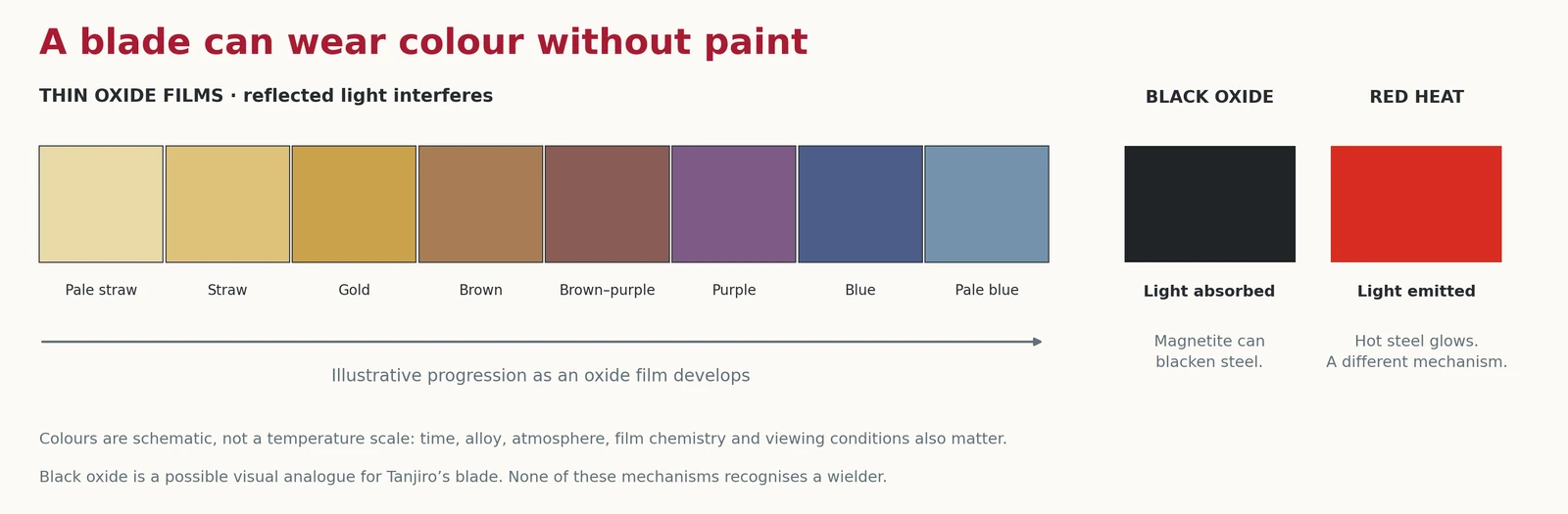
Figure 1. Three ways to color steel: thin-film interference, black-oxide absorption and red-hot emission. The last is distinct from Rengoku’s everyday blade color. Colors are illustrative.
Here the scale betrays the show in a way I like; blue needs a higher temperature than red. According to the book, Giyu runs hotter than Rengoku. Perhaps it is the guilt he still carries from the Final Selection; Rengoku, innocent, dedicated, and focused, carrying his family’s legacy forward, burns steady and even. The real world gives us the palette; the anime gives each blade a soul to wear it.
But then Tanjiro starts putting the warranty to work.
Rui’s thread snaps his first blade, most likely from concentrated loading followed by rapid crack growth; Tanjiro’s inexperience means he receives the blow at the wrong angle, failing to dissipate the attacking force, which adds bending and twisting the steel was never designed to take. Hardness resists indentation, but toughness is what resists fracture. Against Akaza, Tanjiro hurls the replacement into a fleeing demon and loses it: understandable grief, terrible sword management. Daki subsequently chips another blade: local edge fracture, where contact stresses exceed what the hardened steel can tolerate. Tanjiro is still learning how to use what Haganezuka makes, while fighting opponents far beyond his skill level and the sword’s specifications.
Inosuke, meanwhile, manufactures damage deliberately. Cardinal sin! Yet his jagged blades saw through Daki’s yielding neck during Palisade Bite: points catch and concentrate contact. Useful cutting action, dreadful quality control. Properly designed serrations would be safer; random chips invite cracks.
Haganezuka watches all of this, and something in him shifts. He has handed over craft that took him years to refine, only to see it return shattered by hands that do not yet understand what they hold. So, he disappears into the mountains to remake himself. His pursuit of an unbreakable sword gives those workouts purpose: strength moves steel; stamina keeps the blows accurate. The manga never gives us a complete forge tour. Real Katana crafting explains his obsession.
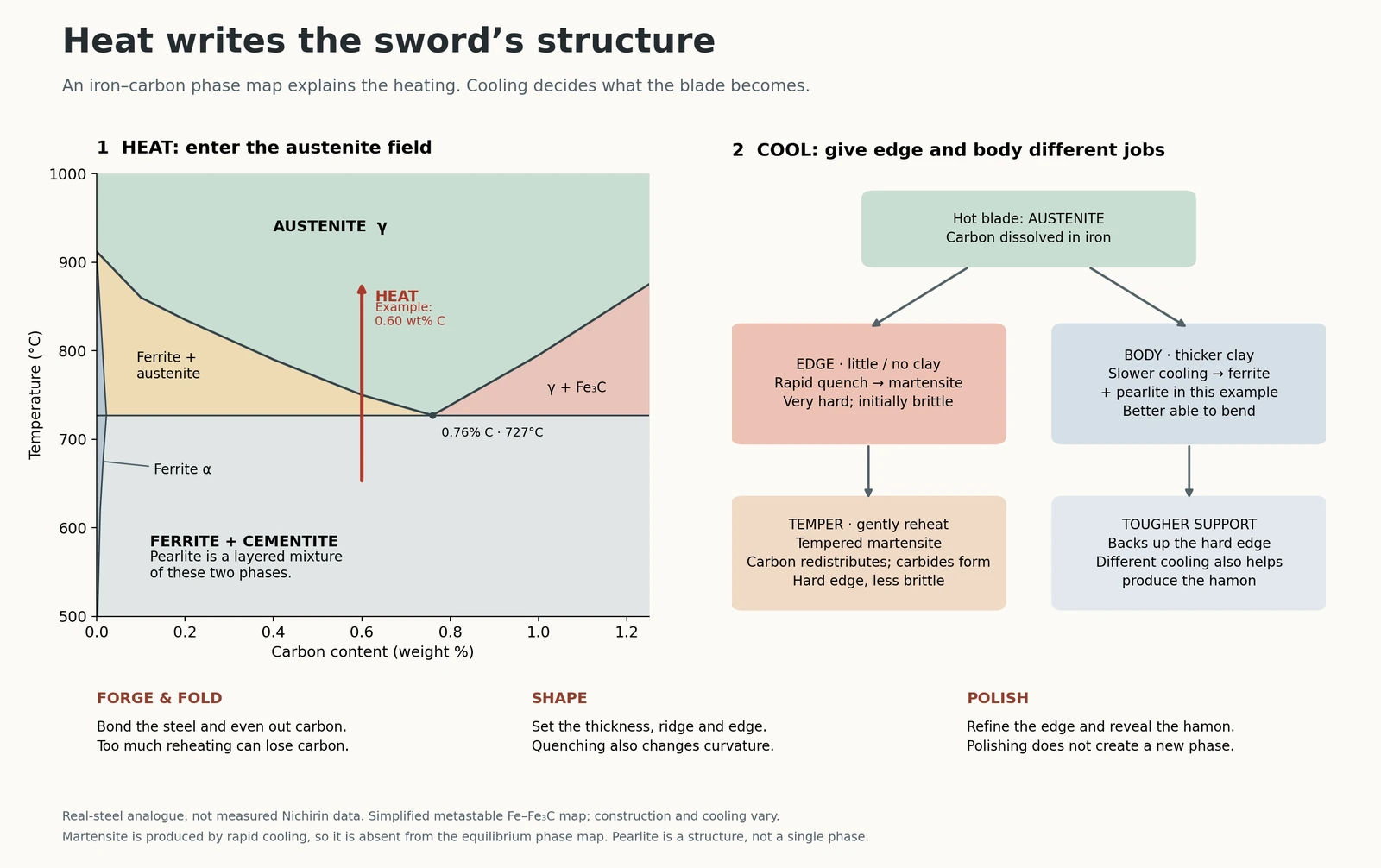
Figure 2. Follow the heating arrow, then the two cooling routes: a hard edge and a tougher supporting body. Real steel analogue; Nichirin composition is unknown.
Iron sand and charcoal yield tamahagane: carbon monoxide removes oxygen from the ore, while carbon enters the metal. The smith sorts, heats, hammers, and folds it, consolidating the steel, breaking up inclusions and evening out carbon. Too much reheating loses carbon. Harder outer steel can embrace a softer core; hammering and filing establish the blade’s profile.
Now the dangerous part. Clay coats the back more thickly than the edge. Heating forms austenite, an atomic arrangement of iron that accommodates dissolved carbon; quenching traps carbon in hard martensite at the rapidly cooled edge. Slower cooling beneath the clay allows softer ferrite and pearlite. Uneven contraction and transformation help curve the blade. Gentler reheating, tempering, lets carbon redistribute and reduces brittleness. The edge must cut; the body must survive the argument.
Then a sword more than 300 years old emerges from Yoriichi Type Zero.
Haganezuka recognizes exceptional craftsmanship beneath the rust. Fewer crack-starting inclusions, sound welds, fine grains, and well-controlled heat treatment could explain a masterpiece outperforming an ordinary contemporary blade. Age alone improves nothing. Restoring it means progressively finer stones removing corrosion and scratches while preserving its geometry and revealing the hardening pattern. Haganezuka keeps polishing even as Gyokko attacks. That concentration deserves its own Hashira title.
Haganezuka is not the only master in that village. Tecchin’s mastery becomes even more outrageous in Mitsuri’s ribbon-type sword. A real version would need thin, carefully tempered spring steel: halving the thickness reduces bending stiffness eightfold, at unchanged width and material. She gains reach and sweeping attacks; the smith inherits a nightmare of thickness control and repeated bending. Obanai’s waves could be forged hot, ground, hardened, and tempered, their changing edge angles complementing his winding attacks. These are personalities translated into geometry. Kanamori understands that relationship too. Muichiro keeps him on site during Hashira Training to maintain his swords. A dulled edge spreads contact; a chip can conceal a crack. Even a prodigy needs someone watching the steel.
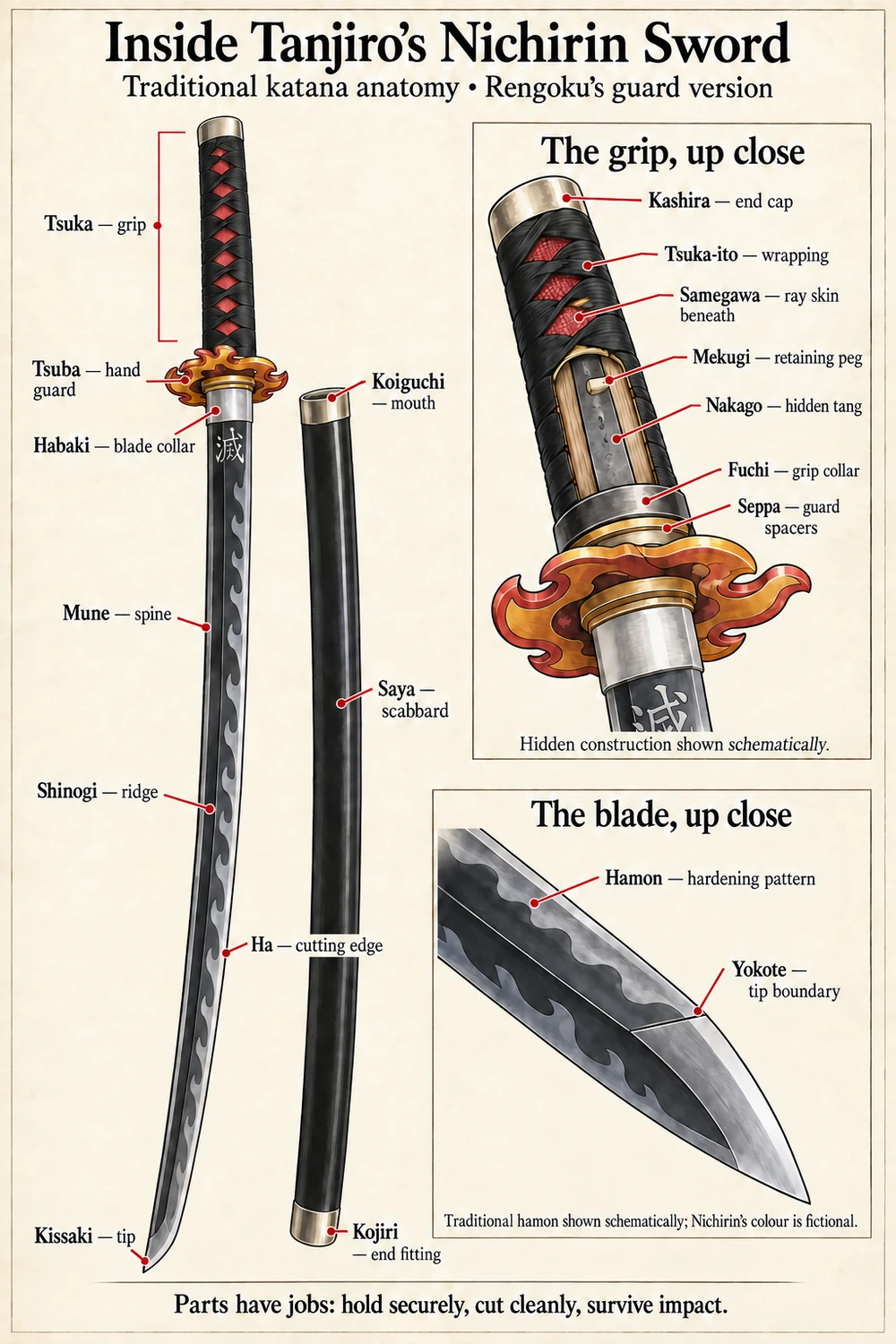
Tanjiro’s restored sword now carries Rengoku’s tsuba, the hand guard. Around it, everything has a job: the ha cuts, the mune supports, the kissaki points, and the hidden nakago anchors the blade inside the tsuka grip.
By the final fights, black gives way to crimson. The transformation is not only in the sword. Tanjiro’s body has changed through seasons of relentless training: his heart rate, his breathing capacity, the density of his muscle, and the heat his body can sustain have all crossed thresholds the story frames as necessary conditions for awakening the Demon Slayer Mark. That mark, burning on his forehead, is the visible proof that his physiology has caught up with his will. Nezuko’s blood flames had already triggered the blade’s first crimson flash in Swordsmith Village; against Muzan, the combination of extreme grip and a body reforged by training produces the red state, with Giyu’s help. Rengoku, who died before any slayer of his generation learned to awaken the mark, carried a blade that was red from the day he first drew it; his crimson was the ore’s reading of his character, not a transformation earned through survival. Real red heat means thermal radiation, but gripping cannot heat an entire sword that way; sustained heating could soften its hardened edge. Some polymers turn red when stretched because force changes their molecules. Borrowing that chemistry for a fictional coating offers a less destructive analogy. The demon-burning power still needs Nichirin’s magic.
More than that, I see Rengoku’s will in that crimson. His tsuba is right there, protecting Tanjiro’s hand. Alongside the Sun Breathing inherited through his family, Tanjiro carries a promise to keep someone else’s fire alive.
Which brings me to what I actually love about Nichirin blades. So much of their story happens at the surface. The color can live in a film thinner than a soap bubble. The cutting edge is where carefully engineered steel finally meets its opponent. Squint a little, and the whole franchise is a surface science story, and I am professionally required to squint at surfaces. Somewhere in that village is a masked man who polishes blades, screams at anyone who chips them, and understands all this through his hands, without a single-phase diagram. Hotaru Haganezuka is the most realistic character in the show. My kind of people, all of them!